
Folk magic practices are rich with cultural significance and spiritual depth. They are deeply rooted in connection with the land and offer practical ways of living a spirit informed life. Modern day folk practices are an honoring of and (oftentimes) a reconstruction of practices that belong to ‘country folk’ of olde.
To put it simply, Folk Magic is the magic of ‘the people’.
Specifically, it’s the magic of common folk…the simple men and women who live on the edges of ‘civilized’ society.
Folk Magic is often misunderstood and illegitimized (feared even). I have personally had to defend my practice in my spiritual circles. Before diving in, let’s look at the likely reasons for this misunderstanding.
The Ruling Class Makes the Rules
In most societal systems, there are two classes: the ruling class, who live in the center of society, and the common folk. Where the ruling class settles, cities spring up. In these cities, they build temples, churches, and synagogues. The people of the city gather to develop and teach a shared spiritual language. Common rituals and practices are then spread throughout the land by those who travel in and out of the city.
These practices are legitimized by the ruling class and their widespread acceptance. Over time, people look at the practices of the city folk as the absolute truth. The traditions of those living outside the city are dismissed and regarded as mere nonsense or even heresy.
This ruling class does not normally represent the majority of the people, yet it speaks ‘for the people’. History is told from the perspective of the ruling class (or the conqueror–but that’s a discussion for another day). Because of this, reconstruction or revival of ‘ancient’ practices often carry the spirit of ‘legitimacy through commonality’, as well.
…but Folklore is History, too
In school, I learned Folklore as history. Maybe it’s because the lore of culture is still young enough to remember the real people who inspired it…maybe it was the isolation that kept the stories alive enough to be considered history. Whatever the case, I learned from an early age that the richest understanding of the past comes from the mouth of the common man.
…and Folk magical practices tell the story of the common man better than any book ever could.
What does Folk Magic Look like?
A lot of Folk Witches I know are kitchen witches…or conjurers. These women know how to bring life and spirit into the things they brew. Whether it’s the spirit of connection and belonging that comes from putting your grandma’s recipe on your family’s table…or the spirit of the land brewed into medicine to heal the sick, one thing is for sure:
…these practices are generational, and steeped in the knowing that comes from decades of practical perfection.
That’s just one example of an endless expression of Folk Magic. People who practice Folk Magic generally bring an odd mix of practicality and superstition. ‘ Common practices include:
- Traditional Dance, Music or Performance that bring about a Spiritual state
- Healing of the spirit or the body by herbal or other earth-based means
- Root Work and Conjuring (covered, below)
- Superstition & Spirit Work (the basis of my ‘spirit healing’ practice)
- Shamanism
- Prayer, chanting, and/or (in my culture) the laying of hands
The expression and ingredients for these practices is as varied as the cultures that keep them alive, but the commonalities persist across most practices. The best place to get started, if you’re looking for a connection to Folk Magic practices is to look at the history of the people in your area or homeland.
It’s all about regional personal expression, after all
My magic is inspired a small region of Southeast West Virginia and the people who settled in the area. More specifically, the magic contained in my family’s personal traditions. I come from a long line of prayer warriors, faith healers, Spirit healers and seers. They wouldn’t admit or associate their practices as being magic, but that makes them no less magical to me.
By following migration patterns, I’ve identified two main cultural streams in my area and my ancestry. This has led me to identify two systems of magical practices that likely informed the traditions in my area:
Pow-wow Folk Magic: Originating from the German settlers in the area, this practice is a rich tradition that I connect with through my Short Granny’s family. Though I’m only beginning to explore it, the more I read and hear, the more I recognize its influence on that side of my family’s traditions.
Root Work: Originating from the Scotch-Irish settlers, this practice has been preserved in my family through the women of the Duncan-Murdock clan. Root work is my primary Folk Magic practice.
Maybe in a separate post, I’ll try to explain root work and my personal connection to it. For now, I’ll just say this:
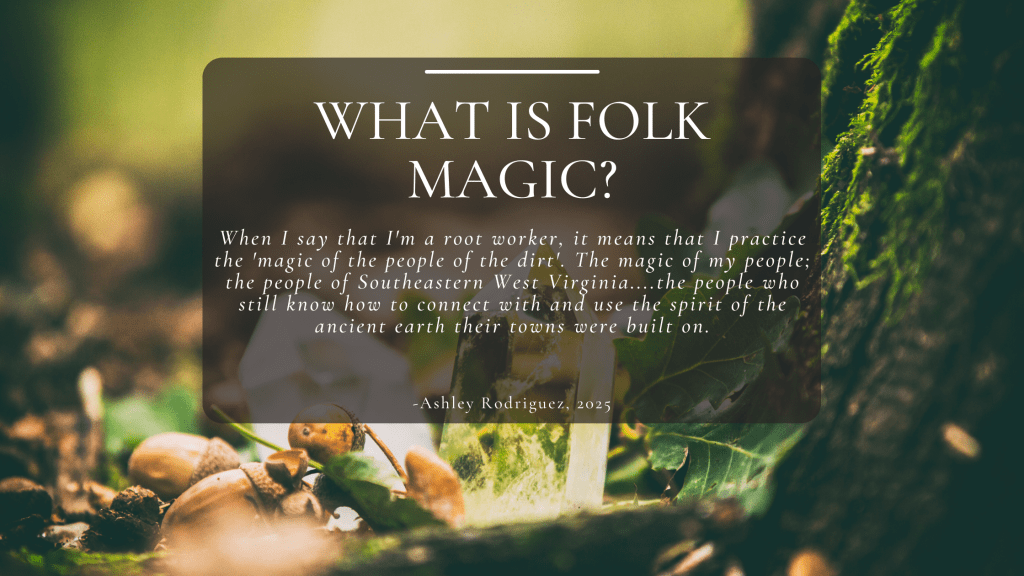
When I say that I’m a root worker, it means that I practice the ‘magic of the people of the dirt’. The magic of my people; the people of Southeastern West Virginia….the people who still know how to connect with and use the spirit of the ancient earth their towns were built on.
Guess what? We all have a little “Folk Witch” in us. It is in our nature to connect to our culture and carry on personal traditions. Even if they’re not inherently spiritual, there is magic in every act honoring one’s cultural and familial traditions.
I’m happy to see people recognizing and reviving the spirit of this magic, once again.


 Ashley Rodriguez
Leave a comment